
Tahitian Pearls
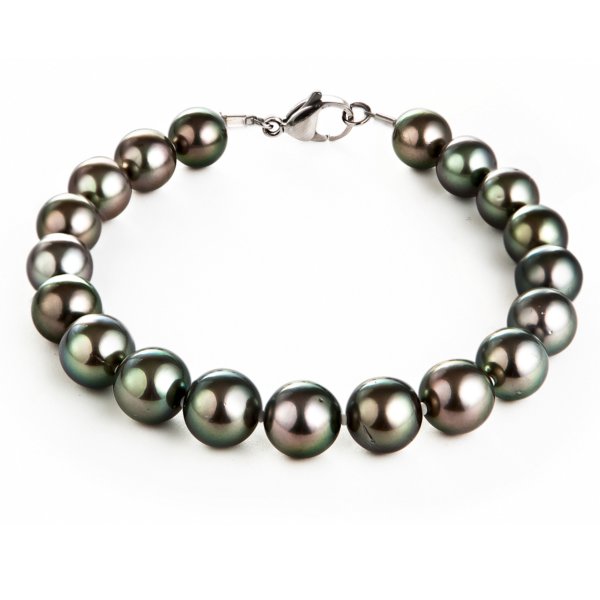
Tahitian pearls hold a singular place in the world of jewelry. Born in the lagoons of French Polynesia, they are the result of a slow natural process shaped by time, water and life itself.
Contrary to a widespread belief, the Tahitian pearl is not truly black. It reveals a depth of color and reflections that shift with the light, the angle and the surface of the pearl. This visual complexity is what makes it a precious and expressive material, impossible to standardize.
A palette of colors born of nature
The Tahitian pearl is often called the "black pearl." The term is misleading: the pearl is almost never a uniform black. Its body color in fact spans a wide range of natural shades. Gray, from the most silvery to the deepest tones, is the most common, followed by green and aubergine.
Over this body color appear reflections known as orient. It is this play of light, shifting with angle and illumination, that gives each pearl its depth and character. Some shades are especially rare and sought after: the so-called peacock reflection, a blend of green, rose and gold, along with pearls showing blue reflections, among the least common.
At diams.com, we select pearls across this entire palette. Because the pearl is a natural material, the colors available change with each harvest: every selection reflects what nature offers at a given moment, with no standardization or treatment.
A living material, shaped by nature
Each Tahitian pearl is unique. Its color, luster and texture result from a natural balance between the oyster, the lagoon and time. This singularity gives every pearl a presence of its own, one that cannot be reproduced or made uniform.
Light plays a central role in how the pearl is perceived. Depending on the lighting and movement, the reflections shift and reveal sometimes unexpected nuances, giving the pearl a particular depth and vibrancy.
A careful selection, pearl by pearl
At diams.com, Tahitian pearls are selected one by one, according to precise and complementary criteria:
luster, essential to the pearl's brightness and vitality
surface quality, assessed as a whole
shape, round or more organic, according to its harmony
overall visual balance
These criteria make it possible to choose coherent pearls, able to engage with a piece of jewelry and with the person who wears it. Natural particularities are not seen as flaws, but as the expression of a living material, as long as they fit within a balanced aesthetic.
Gemological expertise behind every pearl
Every Tahitian pearl offered by diams.com is selected by a gemologist trained at the GIA (Gemological Institute of America). This expertise ensures a precise reading of the pearl, based on objective criteria: luster, which determines its brightness and vitality, surface quality, shape and size.
Each pearl comes with a certificate of authenticity issued by a GIA gemologist. This certificate confirms that it is a genuine Tahitian pearl, that it has undergone no treatment, and sets out its classification according to those same criteria. It is the assurance of a transparent purchase, where the value of the pearl rests on verifiable elements rather than on a mere name.
A respectful, consistent approach
Our approach does not aim for standardization, but for precision. Each pearl is chosen for its ability to fit naturally into a creation, without constraint or artifice.
This approach rests on a deep knowledge of the material and on a direct relationship with partners who specialize in the Tahitian pearl. It ensures a coherent selection, respectful of the pearl's origin and of its very nature.
Pearls meant to be worn and passed on
The Tahitian pearls offered by diams.com belong to a discreet form of jewelry, where the material speaks with simplicity and elegance. They are meant to be worn day to day as well as on more singular occasions, without ostentation.
A well-chosen Tahitian pearl carries through time with ease. It keeps its presence, its light and its character, sustained by the quiet beauty of its form and the depth of its origin.
Discover our Tahitian pearl creations
Our Tahitian pearls come as pendants, earrings, rings, bracelets and necklaces, each set with the same care and accompanied by its certificate. Explore our full range of creations and let yourself be guided by the pearl that speaks to you.
Why is the Tahitian pearl not truly black ?
The term "black pearl" is a generic label. In reality, the Tahitian pearl has a natural body color ranging from silvery gray to deep gray, along with green or aubergine shades, and more rarely peacock or blue reflections. Its color is never a uniform black: it is the depth of its reflections, known as orient, that creates this impression of a dark, shifting hue.
How is the authenticity of a Tahitian pearl guaranteed ?
Each pearl offered by diams.com is examined and selected by a gemologist trained at the GIA. It comes with a certificate confirming its authenticity, the absence of any treatment, and its classification according to precise criteria: size, shape, luster and surface quality. You can review these criteria in detail on our Tahitian pearl classification page.
What determines the price of a Tahitian pearl ?
The price depends on several natural criteria combined: the size of the pearl, expressed in millimeters, its shape (perfectly round pearls being the rarest), the intensity of its luster, the purity of its surface and its color. Some shades, such as peacock or blue, are more sought after because of their rarity. It is the balance between these factors that determines the value of each pearl.
How do you care for Tahitian pearl jewelry ?
The pearl is an organic material that calls for a few simple precautions. It is best to apply perfume and cosmetics before putting on the jewelry, then to wipe the pearl with a soft cloth after wear. Store it flat, away from other jewelry to avoid scratches. Worn regularly, the pearl better retains its natural glow.
Which colors of Tahitian pearls do you offer ?
We select pearls across the full natural palette, from gray to green and aubergine, through to rarer shades such as peacock or blue. The colors available change with each harvest: as the pearl is a natural material, every selection depends on what nature offers at a given moment.
Please complete your information below to login.
Sign In
Create New Account